The importance of clear fire standards
This doesn’t feel like something that needs explaining does it…!
We don’t yet have clear guidance
We do have guidance. In fact we have quite a lot of it. A Government sponsored report in 2023 from ARUP triggered a succession of reports and guidance relating to the implications of installing EV infrastructure underground spaces. Different trade associations, insurers and engineering firms all rushed to produce their version of ‘truth’.
This comes with a clear and evidence downside… No one knows what the ‘eck is going on any more!
Why is current guidance not good enough?
Whilst well intentioned the current guidance available across the industry does a number of things;
It isn’t pragmatic nor actionable. Many of the recommendations simply can’t be implemented due to sky high costs or legal barriers (like Lease protections) that prevent the mitigation work being undertaken (or the budget for it being released).
It is confusing. Guidance is often conflated as ‘fact’. Expert interpretation is often exchanged for binary ‘hit or miss’ approach to mitigations.
What we need
A single, well researched and peer reviewed approach. Such an approach must reflect the complexities and operational characteristics of the built environment. Residential and commercial buildings for example are different. Both in their design and also in the expectations that can be reasonably placed on their occupants for budgets, monitoring, maintenance and management.
Such guidance must be endorsed centrally by Government and ideally cross-departmentally to ensure coherence between the positions of MHCLG, the Building Safety Regulation (and the building regulations) and the Office for Zero Emission Vehicles.
Why we need it urgently
This is not a case of inaction = no change in risk.
Inaction unfortunately here has a number of unintended consequences;
1) EV projects are stiffled leading to failed EV targets, higher air pollution, pressurised vehicle manufacturers and a confused industrial strategy. Businesses and individuals seeking to join the EV transition can’t.
2) The EV mandates will force the presence of EVs regardless of EV infrastructure at these locations. Poor install and charging practices will therefore emerge which in turn lead to an increase in risk even if EV infrastructure has been formally blocked at any given location due to a lack of clear current guidance.
3) Insurers will be dealing with increased emerging and unsighted risk which leads to greater costs for all.
Let’s be reminded though…
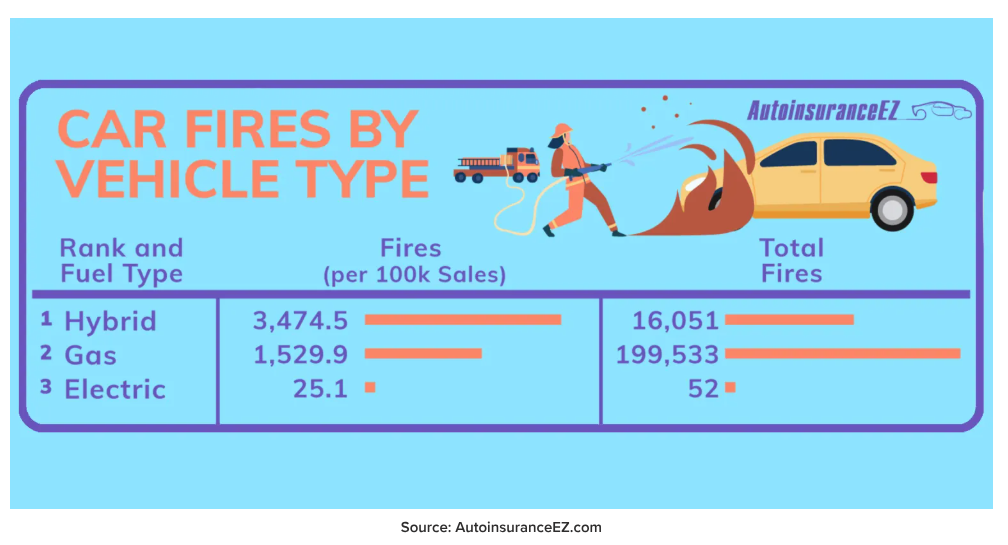
EV’s catch fire significantly less than combustion cars (see image).